Tracked shipping to New Zealand with premium packaging for just NZ$15 

Ship to
New Zealand
0
  • argentina
  • chile
  • colombia
  • españa
  • méxico
  • perú
  • estados unidos
  • internacional

Select your country

Americas

Europe

Rest of the world

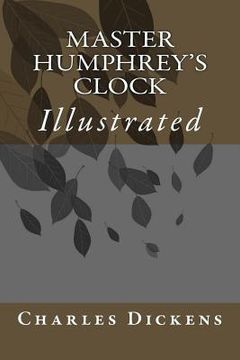
portada Master Humphrey's Clock
Type
Physical Book
Publisher
Language
English
Pages
188
Format
Paperback
Dimensions
22.9 x 15.2 x 1.0 cm
Weight
0.26 kg.
ISBN13
9781541270305

Master Humphrey's Clock

Charles Dickens (Author) · Createspace · Paperback

Master Humphrey's Clock - Charles Dickens

New Book Imported to New Zealand
Delivery: 13 Aug - 25 Aug Shipping: 16 to 20 business days.
NZ$ 51.30
Import costs and 15% GST included in the price ✅
NZ$ 51.30

Synopsis "Master Humphrey's Clock"

Humphrey's Clock (Master Humphrey's Clock) is a weekly paper entirely written by Charles Dickens and published from April 4, 1840 to April 4, 1841. First presented with a story-frame in which Master Humphrey recounts and evokes the circle of His friends, all zealous storytellers including The Pickwick Papers, soon added several news, then the novels The Store of Antiquities and Barnaby Rudge. Master Humphrey is a lonely Londoner of a certain age who likes to collect old manuscripts carefully kept in an old clock at the corner of the fireplace. One fine morning he decided to found a small circle named "The Clock of Master Humphrey," whose members would read all their manuscripts. In addition to Mr. Humphrey himself, there was Jack Redburn, a gentleman afflicted with deafness, Owen Miles, a retired merchant, and Mr. Pickwick, well known to the readers. In the kitchen is the club of servants, led by Sam Weller, the faithful servant of Mr. Pickwick, and who understands the good of Master Humphrey, the barber and, of course, Sam Weller in person. After The Old Curiosity Shop, Master Humphrey introduces Barnaby Rudge, then he is left to his thoughts by the corner of the fireplace. The deaf gentleman takes over; Later, he and his friends return to Humphrey's house where he finds him dead. He bequeathed money to the barber and maid, probably destined to unite by marriage. The deaf man and another friend take care of the house of the deceased and close the club.
Charles Dickens
  (Author)
View Author's Page
Charles Dickens (February 7, 1812 - June 9, 1870) was born in Portsmouth and was the eldest son of a Royal Navy clerk. At twelve, his father's imprisonment for debt forced him to work in a blacking factory. His education was sporadic: he taught himself shorthand, worked as a clerk in a law office, and eventually became a parliamentary correspondent for the Morning Chronicle.

Coming from a humble family, "good old Charles" did not receive formal education until he was nine, and was heavily criticized by the critics of the time for being too self-taught. His life took an unexpected turn with his father's imprisonment for debts, moving his family to live with him in jail, allowed at that time by British laws. At the age of 12, he was already considered fit to start working in a dye factory. Although his family's situation had improved, his mother insisted he keep working there, inspiring him to write one of his masterpieces, David Copperfield.

His articles, later collected in Scenes from London Life by "Boz" (1836-1837), were very successful, and with the appearance in 1837 of The Posthumous Papers of the Pickwick Club, Dickens became a true publishing phenomenon. Novels such as Oliver Twist (1837-1839), Nicholas Nickleby (1838-1839), and Barnaby Rudge (1841) gained enormous popularity, as did some travel chronicles, such as Pictures from Italy (1846). With Dombey and Son (1846-1848) he began his mature period, of which good examples are David Copperfield (1849-1850), his first novel in the first person and his favorite, in which he developed some autobiographical episodes; Bleak House (1852-1853); Little Dorrit (1855-1857), A Tale of Two Cities (1859), Great Expectations (1860-1861), and Our Mutual Friend (1864-1865). He died at Gad's Hill, his country house in Higham, in the county of Kent.
See more
See less

Customers reviews

Frequently Asked Questions about the Book

All books in our catalog are Original.
The book is written in English.
The binding of this edition is Paperback.

Questions and Answers about the Book

Do you have a question about the book? Login to be able to add your own question.

Opinions about Bookdelivery

More customer reviews