Tracked shipping to New Zealand with premium packaging for just NZ$15 

Ship to
New Zealand
0
  • argentina
  • chile
  • colombia
  • españa
  • méxico
  • perú
  • estados unidos
  • internacional

Select your country

Americas

Europe

Rest of the world

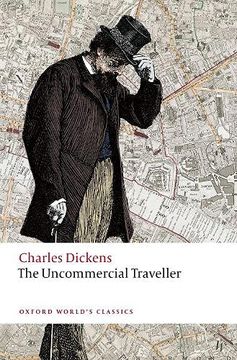
portada The Uncommercial Traveller (Oxford World'S Classics)
Type
Physical Book
Illustrated by
Year
2021
Language
English
Pages
448
Format
Paperback
Dimensions
18.8 x 12.4 x 2.3 cm
Weight
0.29 kg.
ISBN13
9780199686667

The Uncommercial Traveller (Oxford World'S Classics)

Charles Dickens (Author) · Daniel Tyler (Illustrated by) · Oxford University Press · Paperback

The Uncommercial Traveller (Oxford World'S Classics) - Charles Dickens

New Book Imported to New Zealand
Delivery: 28 Jul - 03 Aug Shipping: 3 to 3 business days.
NZ$ 29.18
Import costs and 15% GST included in the price ✅
NZ$ 29.18

Synopsis "The Uncommercial Traveller (Oxford World'S Classics) "

'And O, Angelica, what has become of you, this present Sunday morning when I can't attend to the sermon; and, more difficult question than that, what has become of Me as I was when I sat by your side?' At the height of his career, around the time he was working on Great Expectations and Our Mutual Friend, Charles Dickens wrote a series of sketches, mostly set in London, which he collected as The Uncommercial Traveller. In the persona of 'the Uncommercial', Dickens wanders the city streets andbrings London, its inhabitants, commerce and entertainment vividly to life. Sometimes autobiographical, as childhood experiences are interwoven with adult memories, the sketches include visits to the Paris Morgue, the Liverpool docks, a workhouse, a school for poor children, and the theatre. Theyalso describe the perils of travel, including seasickness, shipwreck, the coming of the railways, and the wretchedness of dining in English hotels and restaurants. The work is quintessential Dickens, with each piece showcasing his imaginative writing style, his keen observational powers, and his characteristic wit. In this edition Daniel Tyler explores Dickens's fascination with the city and the book's connections with concerns evident in his fiction: socialinjustice, human mortality, a fascination with death and the passing of time. Often funny, sometimes indignant, always exuberant, The Uncommercial Traveller is a revelatory encounter with Dickens, and the Victorian city he knew so well.
Charles Dickens
  (Author)
View Author's Page
Charles Dickens (February 7, 1812 - June 9, 1870) was born in Portsmouth and was the eldest son of a Royal Navy clerk. At twelve, his father's imprisonment for debt forced him to work in a blacking factory. His education was sporadic: he taught himself shorthand, worked as a clerk in a law office, and eventually became a parliamentary correspondent for the Morning Chronicle.

Coming from a humble family, "good old Charles" did not receive formal education until he was nine, and was heavily criticized by the critics of the time for being too self-taught. His life took an unexpected turn with his father's imprisonment for debts, moving his family to live with him in jail, allowed at that time by British laws. At the age of 12, he was already considered fit to start working in a dye factory. Although his family's situation had improved, his mother insisted he keep working there, inspiring him to write one of his masterpieces, David Copperfield.

His articles, later collected in Scenes from London Life by "Boz" (1836-1837), were very successful, and with the appearance in 1837 of The Posthumous Papers of the Pickwick Club, Dickens became a true publishing phenomenon. Novels such as Oliver Twist (1837-1839), Nicholas Nickleby (1838-1839), and Barnaby Rudge (1841) gained enormous popularity, as did some travel chronicles, such as Pictures from Italy (1846). With Dombey and Son (1846-1848) he began his mature period, of which good examples are David Copperfield (1849-1850), his first novel in the first person and his favorite, in which he developed some autobiographical episodes; Bleak House (1852-1853); Little Dorrit (1855-1857), A Tale of Two Cities (1859), Great Expectations (1860-1861), and Our Mutual Friend (1864-1865). He died at Gad's Hill, his country house in Higham, in the county of Kent.
See more
See less

Customers reviews

Frequently Asked Questions about the Book

All books in our catalog are Original.
The book is written in English.
The binding of this edition is Paperback.

Questions and Answers about the Book

Do you have a question about the book? Login to be able to add your own question.

Opinions about Bookdelivery

More customer reviews