Tracked shipping to New Zealand with premium packaging for just NZ$15 

Ship to
New Zealand
0
  • argentina
  • chile
  • colombia
  • españa
  • méxico
  • perú
  • estados unidos
  • internacional

Select your country

Americas

Europe

Rest of the world

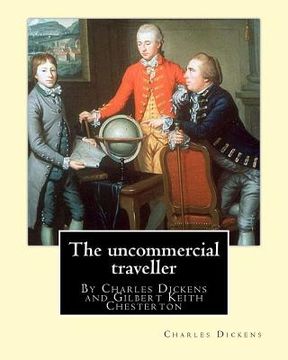
portada The uncommercial traveller, By Charles Dickens, introduction By G. K.Chesterton: By Charles Dickens and Gilbert Keith Chesterton
Type
Physical Book
Publisher
Language
English
Pages
216
Format
Paperback
Dimensions
25.4 x 20.3 x 1.2 cm
Weight
0.44 kg.
ISBN13
9781535018517

The uncommercial traveller, By Charles Dickens, introduction By G. K.Chesterton: By Charles Dickens and Gilbert Keith Chesterton

G. K. Chesterton (Author) · Charles Dickens (Author) · Createspace · Paperback

The uncommercial traveller, By Charles Dickens, introduction By G. K.Chesterton: By Charles Dickens and Gilbert Keith Chesterton - Charles Dickens

New Book Imported to New Zealand
Delivery: 26 Aug - 08 Sep Shipping: 17 to 21 business days.
NZ$ 48.66
Import costs and 15% GST included in the price ✅
NZ$ 48.66

Synopsis "The uncommercial traveller, By Charles Dickens, introduction By G. K.Chesterton: By Charles Dickens and Gilbert Keith Chesterton"

The Uncommercial Traveller is a collection of literary sketches and reminiscences written by Charles Dickens.In 1859 Dickens founded a new journal called All the Year Round and the Uncommercial Traveller articles would be among his main contributions. He seems to have chosen the title and persona of the Uncommercial Traveller as a result of a speech he gave on 22 December 1859 to the Commercial Travellers' School London in his role as honorary chairman and treasurer. The persona sits well with a writer who liked to travel, not only as a tourist, but also to research and report what he found; visiting Europe, America and giving book readings throughout Britain. He does not seem content to rest late in his career when he had attained wealth and comfort and continued travelling locally, walking the streets of London in the mould of the flâneur, a 'gentleman stroller of city streets'. He often suffered from insomnia and his night-time wanderings gave him an insight into some of the hidden aspects of Victorian London, details of which he also incorporated into his novels.he role of the explorer and investigator of interesting things was explained by Dickens in the introduction to the work: Allow me to introduce myself-first negatively. No landlord is my friend and brother, no chambermaid loves me, no waiter worships me, no boots admires and envies me. No round of beef or tongue or ham is expressly cooked for me, no pigeon-pie is especially made for me, no hotel-advertisement is personally addressed to me, no hotel-room tapestried with great-coats and railway wrappers is set apart for me, no house of public entertainment in the United Kingdom greatly cares for my opinion of its brandy or sherry. When I go upon my journeys, I am not usually rated at a low figure in the bill; when I come home from my journeys, I never get any commission. I know nothing about prices, and should have no idea, if I were put to it, how to wheedle a man into ordering something he doesn't want. As a town traveller, I am never to be seen driving a vehicle externally like a young and volatile pianoforte van, and internally like an oven in which a number of flat boxes are baking in layers. As a country traveller, I am rarely to be found in a gig, and am never to be encountered by a pleasure train, waiting on the platform of a branch station, quite a Druid in the midst of a light Stonehenge of samples. And yet-proceeding now, to introduce myself positively-I am both a town traveller and a country traveller, and am always on the road. Figuratively speaking, I travel for the great house of Human Interest Brothers, and have rather a large connection in the fancy goods way. Literally speaking, I am always wandering here and there from my rooms in Covent-garden, London-now about the city streets: now, about the country by-roads-seeing many little things, and some great things, which, because they interest me, I think may interest others. These are my chief credentials as the Uncommercial Traveller. Dickens began by writing seventeen episodes, which were printed in All the Year Round between 28 January and 13 October 1860 and these were published in a single edition in 1861. He sporadically produced eleven more articles between 1863-65 and an expanded edition of the work was printed in 1866. Once more he returned to the persona with some more sketches written 1868-69 and a complete set of these articles was published posthumously in 1875. Gilbert Keith Chesterton, KC*SG (29 May 1874 - 14 June 1936), better known as G. K. Chesterton, was an English writer, [2] poet, philosopher, dramatist, journalist, orator, lay theologian, biographer, and literary and art critic.
G. K. Chesterton
  (Author)
View Author's Page
G. K. Chesterton (London, May 29, 1874 – Beaconsfield, June 14, 1936) was a prolific British writer, author of essays, novels, poetry, biographies, and Christian apologetics. His work is characterized by irony, paradoxical wit, and a critical view of modernity. He was a prominent convert to Catholicism and an influential figure in religious and literary thought of his time. He is also known for his brilliant argumentative style and his defense of common sense.

Among his most recognized works are The Man Who Was Thursday (1908), Orthodoxy (1908), The Innocence of Father Brown (1911), Heretics (1905), The Ball and the Cross (1909), and The Resurrection of Rome (1930). He cultivated the essay, the novel of ideas, detective stories, and social and religious criticism.
See more
See less
Charles Dickens
  (Author)
View Author's Page
Charles Dickens (February 7, 1812 - June 9, 1870) was born in Portsmouth and was the eldest son of a Royal Navy clerk. At twelve, his father's imprisonment for debt forced him to work in a blacking factory. His education was sporadic: he taught himself shorthand, worked as a clerk in a law office, and eventually became a parliamentary correspondent for the Morning Chronicle.

Coming from a humble family, "good old Charles" did not receive formal education until he was nine, and was heavily criticized by the critics of the time for being too self-taught. His life took an unexpected turn with his father's imprisonment for debts, moving his family to live with him in jail, allowed at that time by British laws. At the age of 12, he was already considered fit to start working in a dye factory. Although his family's situation had improved, his mother insisted he keep working there, inspiring him to write one of his masterpieces, David Copperfield.

His articles, later collected in Scenes from London Life by "Boz" (1836-1837), were very successful, and with the appearance in 1837 of The Posthumous Papers of the Pickwick Club, Dickens became a true publishing phenomenon. Novels such as Oliver Twist (1837-1839), Nicholas Nickleby (1838-1839), and Barnaby Rudge (1841) gained enormous popularity, as did some travel chronicles, such as Pictures from Italy (1846). With Dombey and Son (1846-1848) he began his mature period, of which good examples are David Copperfield (1849-1850), his first novel in the first person and his favorite, in which he developed some autobiographical episodes; Bleak House (1852-1853); Little Dorrit (1855-1857), A Tale of Two Cities (1859), Great Expectations (1860-1861), and Our Mutual Friend (1864-1865). He died at Gad's Hill, his country house in Higham, in the county of Kent.
See more
See less

Customers reviews

Frequently Asked Questions about the Book

All books in our catalog are Original.
The book is written in English.
The binding of this edition is Paperback.

Questions and Answers about the Book

Do you have a question about the book? Login to be able to add your own question.

Opinions about Bookdelivery

More customer reviews