Tracked shipping to New Zealand with premium packaging for just NZ$15 

Ship to
New Zealand
0
  • argentina
  • chile
  • colombia
  • españa
  • méxico
  • perú
  • estados unidos
  • internacional

Select your country

Americas

Europe

Rest of the world

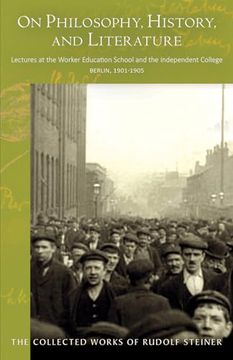
portada On Philosophy, History, and Literature: Lectures at the Worker Education School and the Independent College, Berlin, 1901-1905 (Cw 51)
Type
Physical Book
Introduction by
Translated by
Publisher
Language
English
Pages
348
Format
Paperback
Dimensions
23.4 x 15.0 x 3.0 cm
Weight
0.54 kg.
ISBN13
9781621483212

On Philosophy, History, and Literature: Lectures at the Worker Education School and the Independent College, Berlin, 1901-1905 (Cw 51)

Rudolf Steiner (Author) · Clifford Venho (Introduction by, Translated by) · Steiner Books · Paperback

On Philosophy, History, and Literature: Lectures at the Worker Education School and the Independent College, Berlin, 1901-1905 (Cw 51) - Steiner, Rudolf ; Venho, Clifford ; Venho, Clifford

Cheaper New Book Imported to New Zealand
Delivery: 28 Aug - 07 Sep Shipping: 14 to 15 business days.
NZ$ 89.68
Faster New Book Imported to New Zealand
Delivery: 20 Aug - 27 Aug Shipping: 8 to 9 business days.
NZ$ 91.64
Import costs and 15% GST included in the price ✅
NZ$ 89.68

Synopsis "On Philosophy, History, and Literature: Lectures at the Worker Education School and the Independent College, Berlin, 1901-1905 (Cw 51)"

Author's summary and summaries of 34 lectures, 1901-1905; with reports on Rudolf Steiner's activity in the "Giordano Bruno Association," 1902 (CW 51)"Steiner's approach was at first a surprise for the students, who had been schooled in Marxist thought and tended to view all spiritual matters as 'byproducts' of material, economic processes. For them, it was questionable whether the spiritual striving of individual human beings could really be a driving force in history. Steiner knew the soul disposition of his students and the 'inexpressibly tragic situation' that the proletariat's intense desire for knowledge had so far been 'satisfied only through the grossest form of materialism.' But the materialistic ideas that had been absorbed by the workers from popular scientific literature and from Marxist writings contained 'partial truths.'" (introduction)Wide-ranging, illuminating, and entirely unique in Rudolf Steiner's Collected Works, this volume consists of lectures given at the Worker Education School and at the Independent College in Berlin (along with a lengthy appendix on Steiner's activity in the Giordano Bruno Association). Concerning his teaching activities in the Worker School, Steiner later reflected in his autobiography, "I had to find a completely different way of expressing myself than I had become used to until then" (p. 193). This was due largely to his students' working-class background. Steiner's new approach involved allowing "idealism to arise from materialism." The result was the foundation for what he called "historical symptomatology"--that is, the study of the deeper causes behind history through their symptomatic expression in concrete historical events. This volume is therefore an exceptional resource for anyone interested in Steiner's approach to history.Steiner's lectures at the Independent College, which form part two of the volume, are concerned, on the one hand, with the philosophies of the medieval and early modern mystics--forming a companion to his book Mystics after Modernism (CW 7)--and, on the other, with the remarkable figure of Friedrich Schiller. Speaking on the occasion of the centenary of Schiller's death, Steiner's lectures are a brilliant homage to the great thinker and dramatist, brimming with insights into this extraordinary individual and the significance of his contributions for our time.The appendix contains unique documents outlining Steiner's work in the Giordano Bruno Association for a Unified Worldview. The lively exchange of ideas and Steiner's unique role within the Association are evident in the selected lectures and discussions. This book is a must-read for both long-time students of Steiner's work and newcomers seeking a fresh, enlivened, and enlivening approach to philosophy, history, and literature.On Philosophy, History, and Literature is a translation from German of Über Philosophie, Geschichte, und Literatur. Darstellungen an der Arbeiterbildungsschule und der Freien Hochschule in Berlin, Zusammenstellung edition, Rudolf Steiner Verlag, Dornach, 1983 (GA 51).
Rudolf Steiner
  (Author)
View Author's Page
Rudolf Steiner (Donji Kraljevec, Austro-Hungarian Empire, now Croatia, February 25 or 27, 1861-Dornach, Switzerland, March 30, 1925) was an Austrian philosopher, literary scholar, educator, artist, playwright, social thinker, and occultist. He was the founder of anthroposophy, Waldorf education, biodynamic agriculture, anthroposophic medicine, and the new artistic form of eurythmy.

He described anthroposophy as follows: Anthroposophy is a path of knowledge that would like to lead the spiritual in man to the spiritual in the universe. Those who feel certain questions about the essence of man and the world as a vital necessity as the one felt when we are hungry and thirsty can be anthroposophists.

Steiner proposed a form of ethical individualism, to which he later added a more explicitly spiritual component. He derived his epistemology from the worldview of Johann Wolfgang Goethe, according to which thought is an organ of perception just like the eye or the ear. Just as the eye perceives colors and the ear sounds, so thought perceives ideas.
See more
See less

Customers reviews

Frequently Asked Questions about the Book

All books in our catalog are Original.
The book is written in English.
The binding of this edition is Paperback.

Questions and Answers about the Book

Do you have a question about the book? Login to be able to add your own question.

Opinions about Bookdelivery

More customer reviews