Tracked shipping to New Zealand with premium packaging for just NZ$15 

Ship to
New Zealand
0
  • argentina
  • chile
  • colombia
  • españa
  • méxico
  • perú
  • estados unidos
  • internacional

Select your country

Americas

Europe

Rest of the world

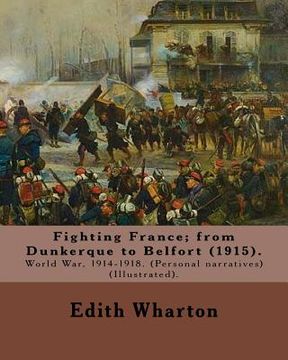
portada Fighting France; from Dunkerque to Belfort (1915). By: Edith Wharton (Illustrated).: World War, 1914-1918. (Personal narratives)
Type
Physical Book
Publisher
Language
English
Pages
68
Format
Paperback
Dimensions
25.4 x 20.3 x 0.4 cm
Weight
0.15 kg.
ISBN13
9781978201293

Fighting France; from Dunkerque to Belfort (1915). By: Edith Wharton (Illustrated).: World War, 1914-1918. (Personal narratives)

Edith Wharton (Author) · Createspace · Paperback

Fighting France; from Dunkerque to Belfort (1915). By: Edith Wharton (Illustrated).: World War, 1914-1918. (Personal narratives) - Wharton, Edith

New Book Imported to New Zealand
Delivery: 10 Sep - 22 Sep Shipping: 17 to 21 business days.
NZ$ 43.50
Import costs and 15% GST included in the price ✅
NZ$ 43.50

Synopsis "Fighting France; from Dunkerque to Belfort (1915). By: Edith Wharton (Illustrated).: World War, 1914-1918. (Personal narratives)"

Edith Wharton ( born Edith Newbold Jones; January 24, 1862 - August 11, 1937) was an American novelist, short story writer, and designer. Wharton combined an insider's view of American aristocracy with a powerful prose style. Her novels and short stories realistically portrayed the lives and morals of the late nineteenth century, an era of decline and faded wealth. She won the Pulitzer Prize for Literature in 1921, and was the first woman to receive this honor. Wharton was acquainted with many of the well-known people of her day, both in America and in Europe, including President Theodore Roosevelt.Edith Wharton was born Edith Newbold Jones to George Frederic Jones and Lucretia Stevens Rhinelander at their brownstone at 14 West Twenty-third Street in New York City. She had two older brothers, Frederic Rhinelander, who was sixteen, and Henry Edward, who was eleven. She was baptized April 20, 1862, Easter Sunday, at Grace Church. To her friends and family she was known as "Pussy Jones."The saying "keeping up with the Joneses" is said to refer to her father's family. She was also related to the Rensselaers, the most prestigious of the old patroon families, who had received land grants from the former Dutch government of New York and New Jersey. She had a lifelong friendship with her niece, the landscape architect Beatrix Farrand of Reef Point in Bar Harbor, Maine. Wharton was born during the Civil War; she was three years old when the Confederate States surrendered. After the war, the family traveled extensively in Europe. From 1866 to 1872, the Jones family visited France, Italy, Germany, and Spain. During her travels, the young Edith became fluent in French, German, and Italian. At the age of ten, she suffered from typhoid fever while the family was at a spa in the Black Forest. After the family returned to the United States in 1872, they spent their winters in New York and their summers in Newport, Rhode Island. While in Europe, she was educated by tutors and governesses. She rejected the standards of fashion and etiquette that were expected of young girls at the time, which were intended to allow women to marry well and to be put on display at balls and parties. She considered these fashions superficial and oppressive. Edith wanted more education than she received, so she read from her father's library and from the libraries of her father's friends.Her mother forbade her to read novels until she was married, and Edith obeyed this command.Wharton began writing poetry and fiction as a young girl, and attempted to write her first novel at age eleven. At age 15, her first published work appeared, a translation of a German poem "Was die Steine Erzählen" ("What the Stones Tell") by Heinrich Karl Brugsch, for which which she was paid $50. Her family did not want her name to appear in print, since writing was not considered a proper occupation for a society woman of her time. Consequently, the poem was published under the name of a friend's father, E. A. Washburn, a cousin of Ralph Waldo Emerson who supported women's education. He played a pivotal role in Edith's efforts to educate herself and encouraged her ambition to write professionally. In 1877, at the age of 15, she secretly wrote a 30,000 word novella "Fast and Loose." In 1878 her father arranged for a collection of two dozen original poems and five translations, Verses, to be privately published. In 1880 she had five poems published anonymously in the Atlantic Monthly, an important literary magazine.Despite these early successes, she was not encouraged by her family or her social circle, and though she continued to write, she did not publish anything more until her poem "The Last Giustiniani" was published in Scribner's Magazine in October 1889....
Edith Wharton
  (Author)
View Author's Page
Edith Wharton was born in New York in 1862. Her maiden name was Edith Newbold Jones. Her family was upper class, comparable to European aristocracy, and consequently she received a meticulous private education. In 1907, she settled in France, where she became a disciple and friend of Henry James. Her most famous work is The Age of Innocence, published in 1920 and winner of the Pulitzer Prize in 1921. She is considered the most brilliant American novelist of her generation, admired by intellectuals of the stature of Henry James, Francis Scott Fitzgerald, Jean Cocteau, and Ernest Hemingway.
See more
See less

Customers reviews

Frequently Asked Questions about the Book

All books in our catalog are Original.
The book is written in English.
The binding of this edition is Paperback.

Questions and Answers about the Book

Do you have a question about the book? Login to be able to add your own question.

Opinions about Bookdelivery

More customer reviews