Tracked shipping to New Zealand with premium packaging for just NZ$15 

Ship to
New Zealand
0
  • argentina
  • chile
  • colombia
  • españa
  • méxico
  • perú
  • estados unidos
  • internacional

Select your country

Americas

Europe

Rest of the world

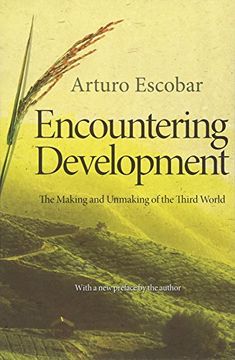
portada Encountering Development: The Making and Unmaking of the Third World
Type
Physical Book
Year
2011
Language
English
Pages
344
Format
Paperback
ISBN13
9780691150451
Edition No.
2011

Encountering Development: The Making and Unmaking of the Third World

Arturo Escobar (Author) · Princeton University Press · Paperback

Encountering Development: The Making and Unmaking of the Third World - Arturo Escobar

Cheaper New Book Imported to New Zealand
Delivery: 24 Jul - 05 Aug Shipping: 13 to 17 business days.
NZ$ 81.81
Faster New Book Imported to New Zealand
Delivery: 10 Jul - 16 Jul Shipping: 3 to 3 business days.
NZ$ 86.28
Import costs and 15% GST included in the price ✅
NZ$ 81.81

Synopsis "Encountering Development: The Making and Unmaking of the Third World "

How did the industrialized nations of North America and Europe come to be seen as the appropriate models for post-World War II societies in Asia, Africa, and Latin America? How did the postwar discourse on development actually create the so-called Third World? And what will happen when development ideology collapses? To answer these questions, Arturo Escobar shows how development policies became mechanisms of control that were just as pervasive and effective as their colonial counterparts. The development apparatus generated categories powerful enough to shape the thinking even of its occasional critics while poverty and hunger became widespread. "Development" was not even partially "deconstructed" until the 1980s, when new tools for analyzing the representation of social reality were applied to specific "Third World" cases. Here Escobar deploys these new techniques in a provocative analysis of development discourse and practice in general, concluding with a discussion of alternative visions for a postdevelopment era. Escobar emphasizes the role of economists in development discourse--his case study of Colombia demonstrates that the economization of food resulted in ambitious plans, and more hunger. To depict the production of knowledge and power in other development fields, the author shows how peasants, women, and nature became objects of knowledge and targets of power under the "gaze of experts." In a substantial new introduction, Escobar reviews debates on globalization and postdevelopment since the book's original publication in 1995 and argues that the concept of postdevelopment needs to be redefined to meet today's significantly new conditions. He then calls for the development of a field of "pluriversal studies," which he illustrates with examples from recent Latin American movements.
Arturo Escobar
  (Author)
View Author's Page
Arturo Escobar (Manizales, Colombia, November 20, 1952) is an influential anthropologist and critical thinker, known for his work in political ecology, development anthropology, social movements, and decolonial studies. He was a professor at the University of North Carolina until 2018 and is currently linked to the doctoral programs in Environmental Sciences at the University of Valle and in Design and Creation at the University of Caldas, in Colombia.

Escobar is known for his critique of the Western development model and his proposal of alternatives based on autonomy, relationality, and the pluriverse. His most influential book is The Invention of Development (1995), which questions the dominant narratives about progress and proposes an alternative vision centered on cultural and epistemological diversity.

In his most recent work, Relationality: An Emerging Politics of Life Beyond the Human (2024), co-written with Michal Osterweil and Kriti Sharma, Escobar explores the idea of radical relationality, which understands that all entities are the result of a network of interrelations and interdependencies, and proposes a politics based on the interconnection and interdependence of all forms of life.

Throughout his career, Escobar has worked closely with Afro-Colombian communities, environmentalists, and feminists, supporting their struggles for territory, identity, and social justice. His approach seeks to promote transitions to more sustainable and just life models, based on respect for diversity and the interconnection of all living beings.
See more
See less

Customers reviews

Frequently Asked Questions about the Book

All books in our catalog are Original.
The book is written in English.
The binding of this edition is Paperback.

Questions and Answers about the Book

Do you have a question about the book? Login to be able to add your own question.

Opinions about Bookdelivery

More customer reviews