Tracked shipping to New Zealand with premium packaging for just NZ$15 

Ship to
New Zealand
0
  • argentina
  • chile
  • colombia
  • españa
  • méxico
  • perú
  • estados unidos
  • internacional

Select your country

Americas

Europe

Rest of the world

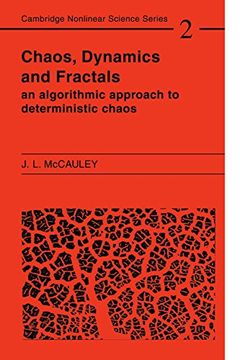
portada Chaos, Dynamics, and Fractals: An Algorithmic Approach to Deterministic Chaos (Cambridge Nonlinear Science Series)
Type
Physical Book
Year
1994
Language
English
Pages
348
Format
Paperback
ISBN
0521467470
ISBN13
9780521467476
Categories

Chaos, Dynamics, and Fractals: An Algorithmic Approach to Deterministic Chaos (Cambridge Nonlinear Science Series)

Joseph Mccauley (Author) · Cambridge University Press · Paperback

Chaos, Dynamics, and Fractals: An Algorithmic Approach to Deterministic Chaos (Cambridge Nonlinear Science Series) - Joseph Mccauley

New Book Imported to New Zealand
Delivery: 21 Oct - 28 Oct Shipping: 5 to 6 business days.
NZ$ 197.62
Import costs and 15% GST included in the price ✅
NZ$ 197.62

Synopsis "Chaos, Dynamics, and Fractals: An Algorithmic Approach to Deterministic Chaos (Cambridge Nonlinear Science Series) "

This book develops deterministic chaos and fractals from the standpoint of iterated maps, but the method of analysis and choice of emphasis make it very different from all other books in the field. It is written to provide the reader with an introduction to more recent developments, such as weak universality, multifractals, and shadowing, as well as to older subjects such as universal critical exponents, devil's staircases, and the Farey tree. Throughout the book the author uses a fully discrete method, a "theoretical computer arithmetic," because finite (but not fixed) precision is a fact of life that cannot be avoided in computation or in experiment. This approach leads to a more general formulation in terms of symbolic dynamics and to the idea of weak universality. The author explains why continuum analysis, computer simulations, and experiments form three entirely distinct approaches to chaos theory. In the end, the connection is made with Turing's ideas of computable numbers. It is explained why the continuum approach leads to predictions that are not necessarily realized in computations or in nature, whereas the discrete approach yields all possible histograms that can be observed or computed.

Customers reviews

Frequently Asked Questions about the Book

All books in our catalog are Original.
The book is written in English.
The binding of this edition is Paperback.

Questions and Answers about the Book

Do you have a question about the book? Login to be able to add your own question.

Opinions about Bookdelivery

More customer reviews