Tracked shipping to New Zealand with premium packaging for just NZ$15 

Ship to
New Zealand
0
  • argentina
  • chile
  • colombia
  • españa
  • méxico
  • perú
  • estados unidos
  • internacional

Select your country

Americas

Europe

Rest of the world

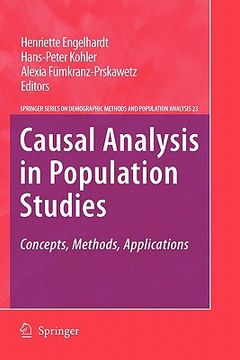
portada causal analysis in population studies: concepts, methods, applications
Type
Physical Book
Publisher
Year
2010
Language
English
Pages
252
Format
Paperback
Dimensions
23.4 x 15.6 x 1.4 cm
Weight
0.37 kg.
ISBN
9048182328
ISBN13
9789048182329

causal analysis in population studies: concepts, methods, applications

Henriette Engelhardt (Illustrated by) · Hans-Peter Kohler (Illustrated by) · Alexia Fürnkranz-Prskawetz (Illustrated by) · Springer · Paperback

causal analysis in population studies: concepts, methods, applications - Engelhardt, Henriette ; Kohler, Hans-Peter ; Fürnkranz-Prskawetz, Alexia

Cheaper New Book Imported to New Zealand
Delivery: 28 Aug - 10 Sep Shipping: 12 to 16 business days.
NZ$ 224.70
Faster New Book Imported to New Zealand
Delivery: 18 Aug - 25 Aug Shipping: 4 to 5 business days.
NZ$ 368.39
Import costs and 15% GST included in the price ✅
NZ$ 224.70

Synopsis "causal analysis in population studies: concepts, methods, applications"

The central aim of many studies in population research and demography is to explain cause-effect relationships among variables or events. For decades, population scientists have concentrated their efforts on estimating the 'causes of effects' by applying standard cross-sectional and dynamic regression techniques, with regression coefficients routinely being understood as estimates of causal effects. The standard approach to infer the 'effects of causes' in natural sciences and in psychology is to conduct randomized experiments. In population studies, experimental designs are generally infeasible. In population studies, most research is based on non-experimental designs (observational or survey designs) and rarely on quasi experiments or natural experiments. Using non-experimental designs to infer causal relationships--i.e. relationships that can ultimately inform policies or interventions--is a complex undertaking. Specifically, treatment effects can be inferred from non-experimental data with a counterfactual approach. In this counterfactual perspective, causal effects are defined as the difference between the potential outcome irrespective of whether or not an individual had received a certain treatment (or experienced a certain cause). The counterfactual approach to estimate effects of causes from quasi-experimental data or from observational studies was first proposed by Rubin in 1974 and further developed by James Heckman and others. This book presents both theoretical contributions and empirical applications of the counterfactual approach to causal inference.

Customers reviews

Frequently Asked Questions about the Book

All books in our catalog are Original.
The book is written in English.
The binding of this edition is Paperback.

Questions and Answers about the Book

Do you have a question about the book? Login to be able to add your own question.

Opinions about Bookdelivery

More customer reviews