Tracked shipping to New Zealand with premium packaging for just NZ$15 

Ship to
New Zealand
0
  • argentina
  • chile
  • colombia
  • españa
  • méxico
  • perú
  • estados unidos
  • internacional

Select your country

Americas

Europe

Rest of the world

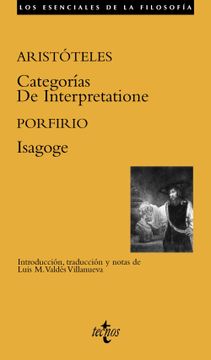
portada Categorias (in Spanish)
Type
Physical Book
Publisher
Collection
Filosofía - Los esenciales de la Filosofía
Year
2012
Language
Spanish
Pages
264
Format
Paperback
Dimensions
20.50 x 12.50
ISBN
8430956050
ISBN13
9788430956050
Edited in
España
Edition No.
1

Categorias (in Spanish)

Aristóteles (Author) · Tecnos · Paperback

Categorias (in Spanish) - Aristóteles

5 estrellas - de un total de 5 estrellas 2 reviews
New Book Imported to New Zealand
Delivery: 18 Aug - 27 Aug Shipping: 7 to 10 business days.
NZ$ 65.10
Import costs and 15% GST included in the price ✅
NZ$ 65.10

Synopsis "Categorias (in Spanish)"

Las dos obras recogidas en este volumen -de capital importancia tanto por sí mismas como por su extraordinaria influencia a lo largo de la historia de la filosofía occidental- inauguran el conjunto de los escritos de Aristóteles sobre lógica, que fueron agrupados por lo menos desde el siglo I a. de C. en el Órganon (literalmente, «instrumento»). Según la tradición más consolidada, la primera de ellas, las Categorías, se ocupa de los elementos simples que conforman los enunciados, mientras que la segunda, el tratado De Interpretatione, versa sobre los enunciados mismos -los componentes de los silogismos que son, a su vez, el objeto de los libros de lógica, los denominados Analíticos-. Sin embargo, ya desde la Antigüedad surgieron disputas acerca, tanto de la ordenación de las obras que habían de componer el Órganon como de su finalidad dentro de la lógica de Aristóteles. En esta nueva edición, tanto la traducción como las introducciones y los comentarios que la acompañan permiten al lector tener presente un punto de vista, diferente del tradicional, en el que, la lógica de Aristóteles se contempla también desde el punto de vista de la argumentación dialéctica sin que por ello se descuide su importancia para el desarrollo de la lógica formal. El libro incluye también la Isagoge (literalmente, «Introducción») de Porfirio (siglo II), una breve y modesta obra diseñada, en principio, como ayuda para el estudio de las Categorías y que, por obra de los traductores y comentadores altomedievales, devino durante mas de milenio y medio la puerta por la que todo estudiante accedía al Órganon y, por tanto, a la filosofía, además de haber sido la fuente de disputas filosóficas tan influyentes, aún en nuestros días, como el problema de los universales. La traducción, introducciones y notas han sido realizadas por Luis M. Valdés Villanueva, en la actualidad catedrático de Lógica y Filosofía de la Ciencia de la Universidad de Oviedo.
Aristóteles
  (Author)
View Author's Page
Aristotle (Stagira, 384 BC-Chalcis, 322 BC) was a philosopher, polymath, and Greek scientist born in the city of Stagira, in the north of Ancient Greece. He is considered, along with Plato, the father of Western philosophy. His ideas have had a huge influence on the intellectual history of the West for more than two millennia.

He was a disciple of Plato and other thinkers, such as Eudoxus of Cnidus, during the twenty years he was at the Academy of Athens. Shortly after Plato's death, Aristotle left Athens to be the tutor of Alexander the Great in the Kingdom of Macedonia for almost 5 years. In the last stage of his life, he founded the Lyceum in Athens, where he taught until a year before his death.

Aristotle wrote about 200 works, of which only 31 have been preserved (none of them intended for publication) in the Corpus Aristotelicum on a wide variety of topics, including: logic, metaphysics, philosophy of science, ethics, political philosophy, aesthetics, rhetoric, physics, astronomy, and biology. Aristotle transformed many, if not all, of the areas of knowledge he addressed. He is recognized as the founding father of logic and biology, since although there are reflections and writings on both subjects before him, it is in Aristotle's work that the first systematic investigations are found. Aristotle has also been called the father of political science, zoology, embryology, natural law, scientific method, rhetoric, psychology, realism, criticism, individualism, teleology, and meteorology.
See more
See less

Customers reviews

Platonyo@Gmail.com Martínez Rocha Angel Tuesday, July 23, 2019
Verified Purchase

Como siempre seguros, confiables y atentos. Los libros que venden cumplen con las expectativas del usuario lector. ¡Muchas Gracias!

00
Pablo Ianiszewski Tuesday, April 04, 2023
Verified Purchase

Cien por ciento satisfecho con la compra del libro.

00
  • 100% (2)
  • 0% (0)
  • 0% (0)
  • 0% (0)
  • 0% (0)

Frequently Asked Questions about the Book

All books in our catalog are Original.
The book is written in Spanish.
The binding of this edition is Paperback.

Questions and Answers about the Book

Do you have a question about the book? Login to be able to add your own question.

Opinions about Bookdelivery

More customer reviews