Tracked shipping to New Zealand with premium packaging for just NZ$15 

Ship to
New Zealand
0
  • argentina
  • chile
  • colombia
  • españa
  • méxico
  • perú
  • estados unidos
  • internacional

Select your country

Americas

Europe

Rest of the world

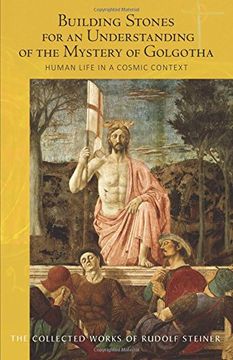
portada Building Stones for an Understanding of the Mystery of Golgotha: Human Life in a Cosmic Context (Cw 175)
Type
Physical Book
Language
English
Pages
400
Format
Paperback
Dimensions
23.1 x 15.2 x 3.0 cm
Weight
0.68 kg.
ISBN13
9781855844209

Building Stones for an Understanding of the Mystery of Golgotha: Human Life in a Cosmic Context (Cw 175)

Rudolf Steiner (Author) · Simon Blaxland-de Lange (Translated by) · Marie Steiner-Von Sivers (Introduction by) · Rudolf Steiner Press · Paperback

Building Stones for an Understanding of the Mystery of Golgotha: Human Life in a Cosmic Context (Cw 175) - Steiner, Rudolf ; Steiner-Von Sivers, Marie ; Blaxland-de Lange, Simon

New Book Imported to New Zealand
Delivery: 19 Aug - 27 Aug Shipping: 7 to 9 business days.
NZ$ 70.14
Import costs and 15% GST included in the price ✅
NZ$ 70.14

Synopsis "Building Stones for an Understanding of the Mystery of Golgotha: Human Life in a Cosmic Context (Cw 175)"

17 lectures, Berlin, February 6 - May 8, 1917 (CW 175)"If one is unable to conceive of the Christ mystery as a true reality, one also cannot develop any ideas and concepts relating to the rest of world existence that are imbued with reality, which really penetrate to the truth." -- Rudolf SteinerIn these lectures, Rudolf Steiner shines fresh light on the historical background and esoteric meaning of what he calls "the central event of human and earthly history"--the Christ mystery, or the Mystery of Golgotha. Basing his commentaries on personal spiritual research, he emphasizes the key nature of the Mystery of Golgotha, through which "something was accomplished that has to do not with the moral order alone, but also with the whole world order in its entirety." This relates to a transformation of the spiritual environment of the Earth and a potentially radical change in human consciousness.Building on the core themes of this course, Steiner presents a variety of fascinating topics, including original sin and the idea of resurrection; faith and knowledge; the nature of sleep and the mystery of fatigue; violation of the mysteries by Roman Emperors; teachings of Mani and Augustine; our relationship to the so-called dead through spiritualistic séances; and the correspondence among the Platonic year, a day in one's life, and a human lifetime.Delivered to audiences a century ago, these lectures have not lost their resonance--indeed, their essential message may be more relevant than ever. They are published here in a new translation and for the first time in a complete English edition."So let us endeavor to make Spiritual Science our own, not merely as a teaching but as a language, and then wait until we find the questions in this language that we may address to Christ. He will answer--yes, he will answer!"This volume is a translation from German of Bausteine zu einer Erkenntnis des Mysteriums von Golgotha. Kosmische und menschliche Metamorphose (GA 175).
Rudolf Steiner
  (Author)
View Author's Page
Rudolf Steiner (Donji Kraljevec, Austro-Hungarian Empire, now Croatia, February 25 or 27, 1861-Dornach, Switzerland, March 30, 1925) was an Austrian philosopher, literary scholar, educator, artist, playwright, social thinker, and occultist. He was the founder of anthroposophy, Waldorf education, biodynamic agriculture, anthroposophic medicine, and the new artistic form of eurythmy.

He described anthroposophy as follows: Anthroposophy is a path of knowledge that would like to lead the spiritual in man to the spiritual in the universe. Those who feel certain questions about the essence of man and the world as a vital necessity as the one felt when we are hungry and thirsty can be anthroposophists.

Steiner proposed a form of ethical individualism, to which he later added a more explicitly spiritual component. He derived his epistemology from the worldview of Johann Wolfgang Goethe, according to which thought is an organ of perception just like the eye or the ear. Just as the eye perceives colors and the ear sounds, so thought perceives ideas.
See more
See less

Customers reviews

Frequently Asked Questions about the Book

All books in our catalog are Original.
The book is written in English.
The binding of this edition is Paperback.

Questions and Answers about the Book

Do you have a question about the book? Login to be able to add your own question.

Opinions about Bookdelivery

More customer reviews