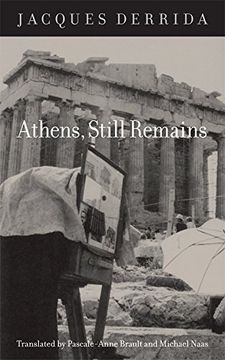
Athens, Still Remains: The Photographs of Jean-Francois Bonhomme
Jacques Derrida
Synopsis "Athens, Still Remains: The Photographs of Jean-Francois Bonhomme "
Athens, Still Remains is an extended commentary on a series of photographs of contemporary Athens by the French photographer Jean-Francois Bonhomme. But in Derrida's hands commentary always has a way of unfolding or, better, developing in several unexpected and mutually illuminating directions. First published in French and Greek in 1996, Athens, Still Remains is Derrida's most sustained analysis of the photographic medium in relationship to the history of philosophy and his most personal reflection on that medium. At once photographic analysis, philosophical essay, and autobiographical narrative, Athens, Still Remains presents an original theory of photography and throws a fascinating light on Derrida's life and work. The book begins with a sort of verbal snapshot or aphorism that haunts the entire book: "we owe ourselves to death." Reading this phrase through Bonhomme's photographs of both the ruins of ancient Athens and contemporary scenes of a still-living Athens that is also on its way to ruin and death, Derrida interrogates a philosophical tradition that runs from Socrates to Heidegger in which the human-and especially the philosopher-is thought to owe himself to death, to a certain thought of death or comportment with regard to death. Combining philosophical speculations on mourning and death, event and repetition, and time and difference with incisive commentary on Bonhomme's photographs and a narrative of Derrida's 1995 trip to Greece, Athens, Still Remains is one of Derrida's most accessible, personal, and moving works without being, for all that, any less philosophical. As Derrida reminds us, the word photography-an eminently Greek word-means "the writing of light," and it brings together today into a single frame contemporary questions about the work of art in the age of mechanical reproduction and much older questions about the relationship between light, revelation, and truth-in other words, an entire philosophical tradition that first came to light in the shadow of the Acropolis.
Jacques Derrida nació el 15 de julio de 1930 en El Biar, Argelia, y murió el 8 de octubre de 2004 en París, Francia. Proveniente de una familia judía sefardí en el contexto del colonialismo francés, su infancia estuvo marcada por acontecimientos que influirían en su sensibilidad filosófica: entre ellos, la experiencia de ser excluido de su liceo en 1942 debido a decretos antijudíos del régimen de Vichy. Posteriormente se trasladó a París para formarse en filosofía, y tras ejercer la enseñanza en la Sorbona y en la École Normale Supérieure, se consolidó como uno de los más influyentes filósofos del siglo XX.
Derrida es sobretodo conocido por haber desarrollado la filosofía de la deconstrucción, un método crítico que analiza cómo los textos, discursos o sistemas de pensamiento contienen oposiciones jerárquicas implícitas (como presencia/ausencia, palabra/escritura, naturaleza/cultura) y muestra cómo esas oposiciones pueden desplazarse o derrumbarse. Su trabajo influyó profundamente en áreas como filosofía, teoría literaria, lingüística, derecho, arquitectura y estudios culturales, sirviendo para cuestionar los fundamentos de la metafísica occidental.
Entre sus obras más destacadas se encuentran Of Grammatology (1967), Writing and Difference (1967) y Margins of Philosophy (1972). A lo largo de su vida académica, abordó temas como la escritura, la diferencia, la presencia, la identidad, la justicia, la memoria y la alteridad. Su estilo, complejo y frecuentemente polémico, generó tanto adhesiones como críticas intensas. Derrida deja un legado que sigue vivo en múltiples disciplinas, movilizando el pensamiento en torno a la apertura, el otro y el procedimiento crítico.