Tracked shipping to New Zealand with premium packaging for just NZ$15 

Ship to
New Zealand
0
  • argentina
  • chile
  • colombia
  • españa
  • méxico
  • perú
  • estados unidos
  • internacional

Select your country

Americas

Europe

Rest of the world

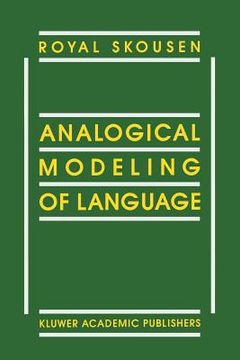
portada Analogical Modeling of Language
Type
Physical Book
Publisher
Language
English
Pages
212
Format
Paperback
Dimensions
23.4 x 15.6 x 1.2 cm
Weight
0.33 kg.
ISBN13
9789401073509

Analogical Modeling of Language

R. Skousen (Author) · Springer · Paperback

Analogical Modeling of Language - Skousen, R.

Cheaper New Book Imported to New Zealand
Delivery: 02 Sep - 14 Sep Shipping: 13 to 17 business days.
NZ$ 224.70
Faster New Book Imported to New Zealand
Delivery: 20 Aug - 27 Aug Shipping: 5 to 6 business days.
NZ$ 303.32
Import costs and 15% GST included in the price ✅
NZ$ 224.70

Synopsis "Analogical Modeling of Language"

1. Structuralist Versus Analogical Descriptions ONE important purpose of this book is to compare two completely dif- ferent approaches to describing language. The first of these approaches, commonly called stnlctllralist, is the traditional method for describing behavior. Its methods are found in many diverse fields - from biological taxonomy to literary criticism. A structuralist description can be broadly characterized as a system of classification. The fundamental question that a structuralist description attempts to answer is how a general contextual space should be partitioned. For each context in the partition, a rule is defined. The rule either specifies the behavior of that context or (as in a taxonomy) assigns a name to that context. Structuralists have implicitly assumed that descriptions of behavior should not only be correct, but should also minimize the number of rules and permit only the simplest possible contextual specifications. It turns out that these intuitive notions can actually be derived from more fundamental statements about the uncertainty of rule systems. Traditionally, linguistic analyses have been based on the idea that a language is a system of rules. Saussure, of course, is well known as an early proponent of linguistic structuralism, as exemplified by his characterization of language as "a self-contained whole and principle of classification" (Saussure 1966:9). Yet linguistic structuralism did not originate with Saussure - nor did it end with "American structuralism".

Customers reviews

Frequently Asked Questions about the Book

All books in our catalog are Original.
The book is written in English.
The binding of this edition is Paperback.

Questions and Answers about the Book

Do you have a question about the book? Login to be able to add your own question.

Opinions about Bookdelivery

More customer reviews