Tracked shipping to New Zealand with premium packaging for just NZ$15 

Ship to
New Zealand
0
  • argentina
  • chile
  • colombia
  • españa
  • méxico
  • perú
  • estados unidos
  • internacional

Select your country

Americas

Europe

Rest of the world

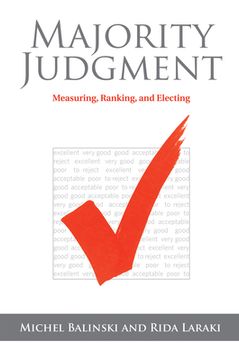
portada Majority Judgment: Measuring, Ranking, and Electing
Type
Physical Book
Publisher
Year
2022
Language
English
Pages
432
Format
Paperback
Dimensions
22.9 x 15.2 x 2.2 cm
Weight
0.58 kg.
ISBN13
9780262545716

Majority Judgment: Measuring, Ranking, and Electing

Michel Balinski (Author) · Rida Laraki (Author) · MIT Press · Paperback

Majority Judgment: Measuring, Ranking, and Electing - Balinski, Michel ; Laraki, Rida

Cheaper New Book Imported to New Zealand
Delivery: 24 Aug - 04 Sep Shipping: 12 to 16 business days.
NZ$ 136.14
Faster New Book Imported to New Zealand
Delivery: 13 Aug - 20 Aug Shipping: 5 to 6 business days.
NZ$ 154.82
Import costs and 15% GST included in the price ✅
NZ$ 136.14

Synopsis "Majority Judgment: Measuring, Ranking, and Electing "

An account of a new theory and method of voting, judging and ranking, majority judgment, shown to be superior to all other known methods. In Majority Judgment, Michel Balinski and Rida Laraki argue that the traditional theory of social choice offers no acceptable solution to the problems of how to elect, to judge, or to rank. They find that the traditional model--transforming the preference lists of individuals into a preference list of society--is fundamentally flawed in both theory and practice. Balinski and Laraki propose a more realistic model. It leads to an entirely new theory and method--majority judgment--proven superior to all known methods. It is at once meaningful, resists strategic manipulation, elicits honesty, and is not subject to the classical paradoxes encountered in practice, notably Condorcet's and Arrow's. They offer theoretical, practical, and experimental evidence--from national elections to figure skating competitions--to support their arguments. Drawing on insights from wine, sports, music, and other competitions, Balinski and Laraki argue that the question should not be how to transform many individual rankings into a single collective ranking, but rather, after defining a common language of grades to measure merit, how to transform the many individual evaluations of each competitor into a single collective evaluation of all competitors. The crux of the matter is a new model in which the traditional paradigm--to compare--is replaced by a new paradigm--to evaluate.

Customers reviews

Frequently Asked Questions about the Book

All books in our catalog are Original.
The book is written in English.
The binding of this edition is Paperback.

Questions and Answers about the Book

Do you have a question about the book? Login to be able to add your own question.

Opinions about Bookdelivery

More customer reviews